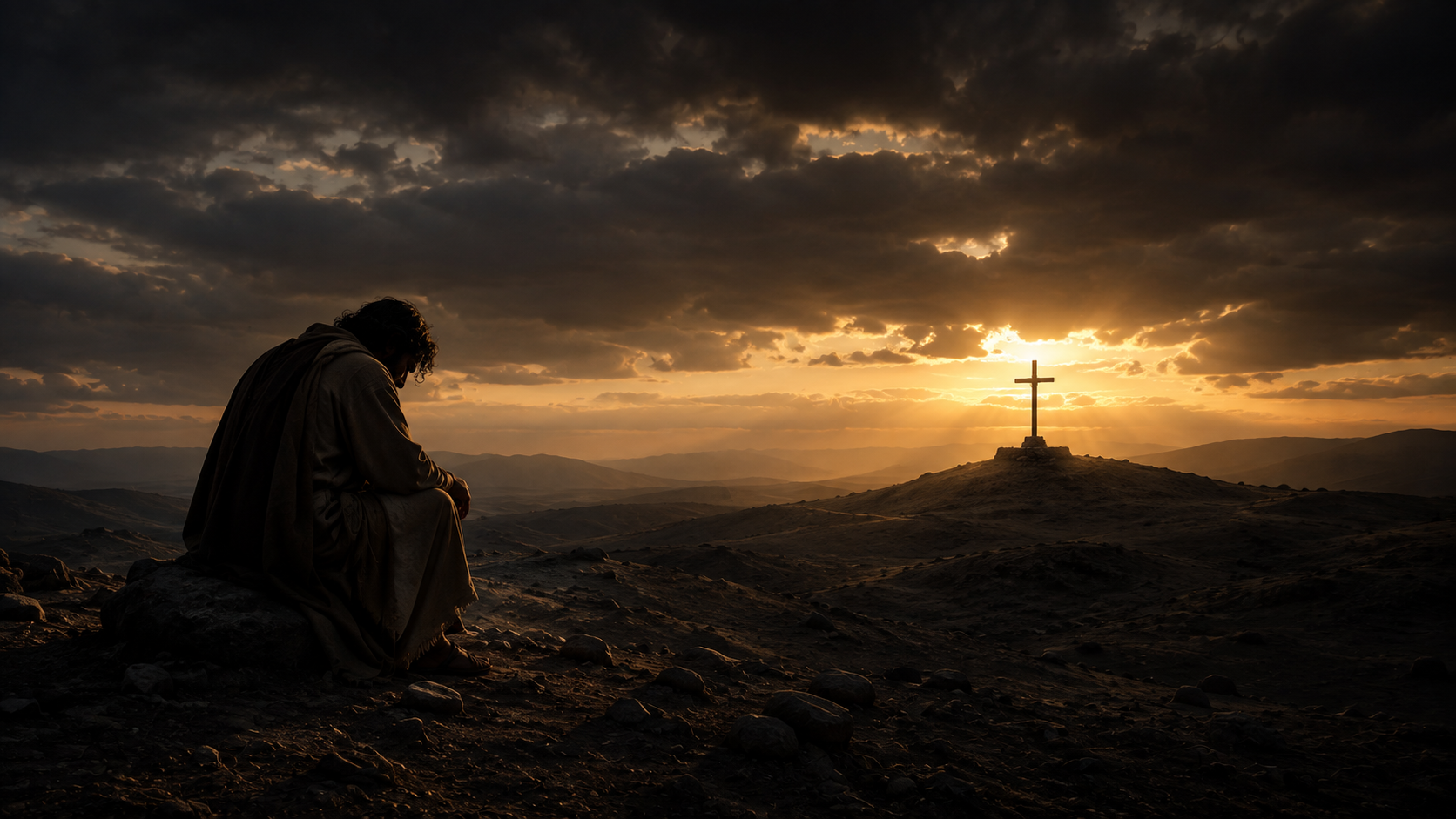
When we open the Psalms, we normally expect words of comfort, songs of praise, or expressions of trust in the goodness of God. There are laments, of course. Yet most of the laments in the Psalter eventually give us some glimmer of hope, some answer to prayer, some turn toward confidence and praise.
Psalm 88 is different. There is no light at the end of the tunnel. It is like the Book of Job without the final chapters. The psalm begins with suffering, and it ends with suffering. In fact, the last word of the psalm in Hebrew is literally “darkness” (maḥšāḵ), and one modern version renders the closing line, “the only friend I have left is Darkness” (88:18, MSG). Not surprisingly, Matthew Henry remarks, “This psalm is a lamentation, one of the most melancholy of all the psalms; and it does not conclude, as usually the melancholy psalms do, with the least intimation of comfort or joy, but, from first to last, it is mourning and woe.”1Matthew Henry, Matthew Henry’s Commentary, 870. Several modern commentators have likewise referred to Psalm 88 as “the darkest” psalm in the Bible.2E. M. Blaiklock, James Montgomery Boice, and Sam Storms are among those who describe Psalm 88 as the darkest psalm.
Why would God give us such a seemingly hopeless psalm? Why would he place within the canon of Scripture a song that ends on such a dark note?
A Closer Look at the Darkest Psalm
The Lament of a Believer
The psalm identifies its author as “Heman the Ezrahite.” This may be the same Heman whom David appointed as a singer in 1 Chronicles 6:33, though we cannot be certain. What we can be sure of is that the Heman of Psalm 88 is a believer. He begins:
“O LORD, God of my salvation,
I have cried out day and night before You.” (Ps. 88:1, NKJV)
Heman calls upon the covenant name of God: “O Yahweh.” He is professing faith in the God who revealed himself to Abraham, Isaac, and Jacob, the God who brought Israel out of Egypt. More than that, he personalizes his confession: Yahweh is “the God of my salvation.” Even as Heman suffers, he knows that his only hope is in the Lord.
This is not the cry of an unbeliever shaking his fist at heaven. It is not the despair of someone who has simply given up on God. It is the lament of a real believer.
That matters because real faith does not always sound like joyful praise. Sometimes faith sounds like groaning, crying, and questioning. Lament is not the opposite of faith. Lament can be faith in its rawest and most desperate form.
The Lament of Profound Suffering
At the end of verse 2, Heman refers to his prayer as a “cry.” The underlying Hebrew term refers to a loud, audible cry and can carry the sense of wailing or lamentation. This is plainly a psalm about suffering, and not merely the ordinary discomforts of life. Heman is not describing a sore back, an upset stomach, or a passing head cold. His affliction is serious, grave, and all-consuming.
First, Heman’s affliction is overwhelming. “My soul is full of troubles” (v. 3). The LSB vividly renders the line, “my soul has been saturated with calamities.” The same sense of inundation appears in verse 17: “They came around me all day long like water; They engulfed me altogether.” His troubles do not merely visit him. They surround and submerge him.
Second, his affliction is debilitating. “I am like a man who has no strength” (v. 4). Later he says, “My eye wastes away because of affliction” (v. 9). The language depicts suffering that exhausts a person physically and emotionally.
Third, his affliction is life-threatening. “My life draws near to the grave” (v. 3). He is “counted with those who go down to the pit” (v. 4), “like the slain who lie in the grave” (v. 5), and laid “in the lowest pit, in darkness, in the depths” (v. 6). Heman sees himself as a man with one foot already in the grave.
Fourth, his affliction is prolonged. The fact that he cries to God “day and night” (v. 1; cf. v. 13) suggests an ongoing trial, but verse 15 puts the matter beyond doubt: “I have been afflicted and ready to die from my youth.” This is not a passing season. Suffering has, in some sense, been the story of Heman’s life. Some believers know exactly what that is like: a burden, sickness, grief, or weakness that has been present for years and simply does not go away.
Two further features make Heman’s suffering especially painful. His affliction isolates him. “You have caused my companions to shun me; you have made me a horror to them. I am shut in so that I cannot escape” (v. 8, ESV). The psalm closes on the same note: “You have caused my beloved and my friend to shun me; my companions have become darkness” (v. 18, ESV). The NLT renders the final clause, “Darkness is my closest friend.” Few things are more painful than suffering alone.
Finally, Heman suffers without hearing God answer his prayers for deliverance. He believes in God’s goodness and sovereignty, and his desire for healing is not merely a desire for an easier life. He wants to live so that he may praise God’s name. That is the force of his argument in verses 10–12:
“Will You work wonders for the dead?
Shall the dead arise and praise You?
Shall Your lovingkindness be declared in the grave?
Or Your faithfulness in the place of destruction?
Shall Your wonders be known in the dark?
And Your righteousness in the land of forgetfulness?” (NKJV)
And yet he continues, “I cry to you for help, O LORD; in the morning my prayer comes before you. Why, O LORD, do you reject me and hide your face from me?” (vv. 13–14). Despite Heman’s fervent prayers, God seems silent.
When God Seems Hidden
This experience touches what philosophers and theologians sometimes call “the hiddenness of God problem.” Some atheists even use divine hiddenness as an argument against God’s existence. Their reasoning runs something like this: a loving parent would hear the desperate cry of a needy child. A loving parent would make his presence known, ease the pain, and comfort the sorrow. Yet Psalm 88 presents a child of God sincerely reaching for God, crying out in anguish and pleading for relief, while God seems hidden and aloof. Therefore, the atheist concludes, God does not exist.
But that is emphatically not Heman’s conclusion. He is a believer who knows Yahweh as “the God of my salvation.” Precisely because he believes, he perseveres in prayer day and night. He continues to seek God’s face.
Still, within the horizon of the psalm, there is no answer. No healing. No deliverance. No resolution. Just darkness. No wonder Sam Storms describes Psalm 88 as “the darkest, most depressing, and saddest of all psalms.”3Sam Storms, “Darkness, My Only Companion (Psalm 88),” May 25, 2007.
At first glance, this hardly seems like good public relations for biblical religion. Psalm 88 probably is not the passage most Christians would instinctively choose to share with an unbelieving neighbor. Yet its presence in Scripture is no accident. This bleak lament is as inspired and profitable as the psalms that end with shouts of praise. Its very darkness teaches us truths we desperately need.
What the Darkest Psalm Teaches Us
Our Best Life Is Not Now
Heman’s lament teaches Christians to be realistic about life in a fallen world. We live under the effects of the curse, in a world marked by sickness, pain, disease, loss, and death. God can answer prayers for healing and relief, and sometimes he does. But he does not promise to remove every affliction in this life. Sometimes he permits his people to suffer profoundly and for a very long time. When he does not remove the pain, it can even feel as though he is hiding his face.
There are preachers who claim that sufficient faith guarantees healing, prosperity, and material well-being. According to that message, the gospel promises health, wealth, and success to believers here and now. It tells Christians that “your best life” is now.
Psalm 88 says otherwise. Heman would have understood Peter’s warning to suffering believers: “Beloved, do not be surprised at the fiery trial when it comes upon you to test you, as though something strange were happening to you” (1 Pet. 4:12). He would also have understood Paul’s declaration, “We must through much tribulation enter the kingdom of God” (Acts 14:22).
The Christian life is not heaven on earth. Our best life is not now. On this side of glory there will be sickness, sorrow, unanswered prayers, and dark nights of the soul. That is an especially important truth to learn while we are young and healthy. Today we may enjoy strength and many of the comforts of life, but sooner or later every one of us encounters the thorns and thistles of the curse. Eventually we return to the dust from which we were made. Rather than destroying Christian hope, that realism should deepen our longing for the life to come.
We Are Not Alone
Psalm 88 also reminds sufferers that they are not alone. We might call it a “psalm of commiseration.” In modern terms, it is something like the blues. And sad songs can be strangely comforting.
When we hear someone else sing honestly about heartbreak, grief, or loneliness, we often realize, “I’m not the only one who feels this way.” We feel understood. Psalm 88 does that for the suffering believer. It validates an experience that can otherwise feel spiritually abnormal. It names pain that we may struggle to put into words. And it teaches us that it is permissible to cry before God and bring our pain to him without tying everything up neatly before the prayer ends.
There is even a kind of catharsis in lament. By leaning into grief and praying the words God himself has given us, we can find a measure of release. In his kindness, God has given his church a Psalter—and a Bible—full of laments because he knows his children will need them.
Our particular trials may be unique in some respects, but suffering itself is not a strange intrusion into the Christian life. Others have gone through the deep waters before us. Others have walked through the fire. The sad songs of Scripture assure us that our grief is not unprecedented and that we do not suffer alone.
Heman Preaches Christ
When Nathanael first heard about Jesus of Nazareth, he asked, “Can anything good come out of Nazareth?” (John 1:46). After spending so much time in Psalm 88, we might ask a similar question: Can anything good come out of this psalm? More specifically, can we find Christ in Psalm 88?
In one sense, the answer is no—or at least, not in the same way that we find Christ in the New Testament. When reading the Old Testament, we need to “remember the plot.” The Bible is a story with a developing plotline, and faithful interpretation requires us to ask where a particular passage falls within that story.
Like other stories, Scripture has an introduction in which the main characters and conflict are introduced. It has rising action, in which the conflict intensifies and attempted resolutions fail. And it has a climax or turning point, where the central figure resolves the conflict and sets in motion the outworking of that resolution.
Psalm 88 belongs to the rising action of Scripture’s story. It is not Genesis 1–3, where the fundamental conflict is introduced, and it is not the New Testament, where the decisive resolution arrives in Christ. Psalm 88 heightens the conflict rather than resolving it. We therefore should not expect Heman to speak with the redemptive-historical fullness of Matthew, Luke, or Paul.
Yet in another and very important sense, the answer is yes. Heman’s sufferings foreshadow the sufferings of Christ. As a writer of Scripture, Heman functions prophetically. His experience and words anticipate, in striking ways, the experience and words of the Messiah.
Heman endured physical and emotional agony; so did Jesus. Isaiah describes the Messiah as “despised and rejected by men, a man of sorrows, acquainted with grief” (Isa. 53:3). In Gethsemane, Jesus cries in words that resonate with Heman’s lament: “If possible, remove this cup of suffering from me” (cf. Mark 14:36).
Heman was abandoned by his friends; so was Jesus. Christ told his disciples, “the hour is coming, yes, has now come, that you will be scattered, each to his own, and will leave Me alone” (John 16:32). When his darkest hour arrived, “the disciples deserted him” (Matt. 26:56).
Heman felt the silence and wrath of God; so did Jesus. From the cross Christ cried, “My God, my God, why have you forsaken me?” (Matt. 27:46). In that awful hour, Jesus could enter fully into the terrible world evoked by Heman’s final words: “darkness is my only friend” (Ps. 88:18).
Heman’s life thus foreshadows Christ’s passion. His lament helps the church remember the Lord’s death and the depth of the suffering into which the Son of God willingly entered. It reminds us that God so loved the world that he did not spare his own Son but delivered him up for us.
The God Who Sympathizes with Sufferers
This Christological dimension of Psalm 88 teaches us, first, that God sympathizes with his suffering children. Because of Jesus, we know that God is not distant from human pain. The Christian God is not merely an abstract “unmoved mover,” untouched by the sorrows of the world. The eternal Son took on flesh. He entered our sorrows, groaned in Gethsemane, wept at Lazarus’s tomb, and cried out in agony on the cross.
For that reason, the author of Hebrews assures believers, “We do not have a high priest who is unable to sympathize with our weaknesses” (Heb. 4:15). Christ does not observe our suffering from a safe distance. He knows suffering from the inside.
This is why Corrie ten Boom’s sister Betsie could say, after enduring the atrocities of a German concentration camp, “There is no pit so deep that [Christ] is not deeper still.”4Corrie ten Boom, The Hiding Place. The believer who cries out with Heman can listen carefully to Psalm 88 and, as it were, hear the voice of Jesus singing the lament alongside him.
The God Who Eventually Answers Lament
Second, Psalm 88 teaches us that God eventually answers the lament of his people, even when the answer does not come within the sufferer’s earthly lifetime. Heman did not see the full answer while he lived. But he sees it now. When Heman was yet without strength, Christ died for him.
Heman now rejoices in the presence of God. He awaits the resurrection of the body and the new heavens and new earth in which righteousness dwells. The darkness that seemed to have the final word in Psalm 88 did not, in fact, have the final word over Heman.
The same is true for every believer. We may feel forgotten now. We may feel as though the darkness will never lift. But Revelation 21:4 promises that God “will wipe every tear from their eyes. There will be no more death or mourning or crying or pain.” The darkness we experience is real. Christianity does not require us to pretend otherwise. But darkness is not the final word.
Darkness Is Not the Final Word
Psalm 88 is God’s gift to the chronically suffering, the depressed, the lonely, and the abandoned. It tells us that our cries are not wasted. It shows us that genuine faith can be tear-stained. Faith can groan, question, and sometimes even sound hopeless while still clinging to “the God of my salvation.”
Heman’s lament also reminds us that there is purpose in the suffering of God’s people even when we cannot see that purpose. There is purpose not only in the “thorn in the flesh” but even in God’s decision, at times, not to remove it. Psalm 88 can therefore teach us to pray with Paul, “That I may know Christ and the power of his resurrection and the fellowship of his sufferings, being conformed to his death” (Phil. 3:10).
Most of all, Heman’s lament points beyond Heman to Christ—the Man of Sorrows who entered the deepest darkness for his people. Because he went there, those who belong to him will one day dwell in eternal light.
So when darkness becomes an old and familiar friend, the Christian need not deny it, minimize it, or pretend that faith always feels triumphant. Heman is there to give us words. Christ is there as the suffering High Priest who understands. And the resurrection is there to assure us that, however long the night may last, sorrow will finally give way to everlasting joy.
Leave a Reply