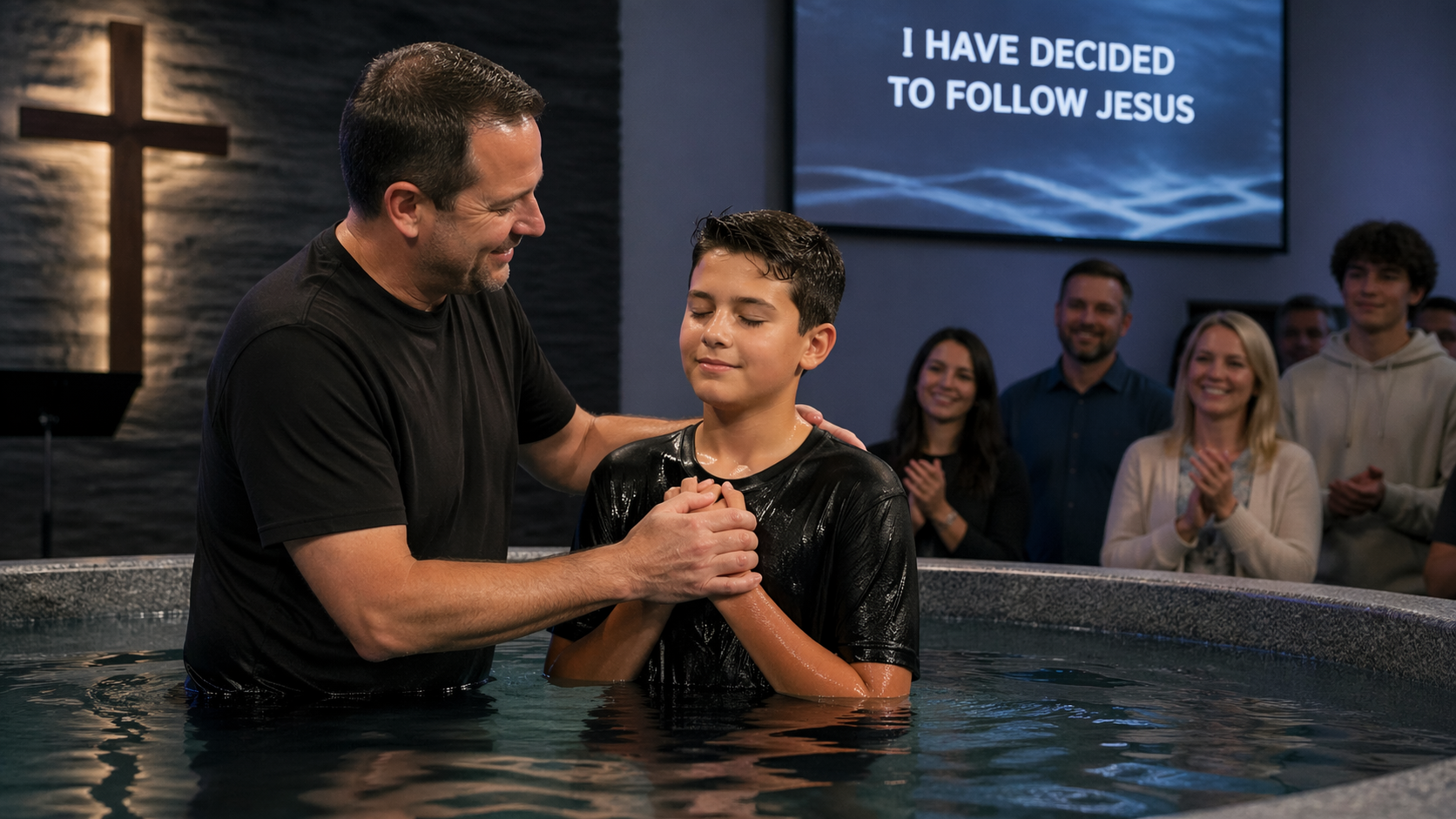
Should we allow minors into the membership of the church? Most evangelical churches would, without hesitation, answer this question affirmatively. Those that practice infant baptism believe the Bible warrants the inclusion of the children of believers into the membership of the church de jure. On the other hand, many Baptist churches today pressure young children to “make a decision for Christ” and accept such decisions or professions of faith without careful reflection on credibility.
On the One Hand …
In response to these two common evangelical views, Reformed Baptists have rightly stressed the need for a profession of faith as a prerequisite for baptism and church membership (contra paedobaptism) and appropriately questioned the often superficial decisionalism that characterizes far too many Baptist churches (contra decisionalism). They have, I think rightly so, highlighted the need to be cautious about hastily accepting as genuine a child’s profession of faith in light of several factors. These include a child’s lack of intellectual maturity (1 Cor 13:11; 14:20; Heb 5:11-14; 11:24-26), a child’s tendency to be changeable in his/her opinions and commitments (Isa 3:4; Matt 11:16-17; Eph 4:13-14), and a child’s proneness to self-deception (Jer 17:9; Ps 58:3; Prov 1:1-4; Eph 4:13-14).1These childlike characteristics are highlighted and expounded in Dennis Gundersen’s excellent study Your Child’s Profession of Faith (Amityville, NY: Calvary Press, 1994). It is also pointed out that Luke, in Acts, refers to adult males and females being added to the church but doesn’t explicitly refer to children (Acts 5:14; 8:3, 12; 9:1-2; 17:4, 34).2See David Merck’s helpful study, “Children and Church Membership,” which can be accessed on the Internet here. Accordingly, some Reformed Baptist churches are hesitant to baptize children and, in some cases, require an individual to reach adult status before he/she may become members of the church.
On the Other Hand …
While I appreciate and share some of the concerns raised by Baptist pastors, I’m decidedly in favor of baptizing and bringing children in to the membership of the church on biblical grounds. To begin with, the Bible teaches that children can be converted and should be urged to believe the gospel (Matt 18:1-6; Matt 19:13-14; Mark 9:42; Luke 18:15-17; Eph 6:1-2). Most, I think, would concede this point. But the Bible says more. In his epistles to the church in Ephesus and to the church in Colossae, the apostle Paul likely contemplates children (i.e., minors) as church members.
To the Saints in Ephesus
For our purposes, we’ll focus primarily on the text in Ephesians. In 6:1, Paul exhorts children, “Obey your parents in the Lord, for this is right” (ESV). The phrase “in the Lord” may suggest that the child is to obey his parents in light of his saving union with Christ (see Rom 16:8, 13; 1 Cor 4:17; 7:22, 39; 15:58; Eph 2:21; 5:8; 6:10; Phil 3:1; 4:1; Col 3:18; 4:7; 1 Thess 3:8; Philemon 1:16; Rev 14:13). Some, however, demur, and argue that the phrase means nothing more than “for the Lord’s sake” or “because the Lord commands such submission.” But there are exegetical data in the larger context that suggest Paul was addressing children whom he assumed were in saving union with Christ and who were, in fact, members of the church in Ephesus.
The Immediate Context
First, it should be noted that 6:1-2 is tied grammatically to 5:21 which, in turn, is linked grammatically to 5:18. Paul’s argument goes something like this: he commands believers to yield themselves to the control of the Spirit rather than the control or influence of wine (5:18). This command is followed by participial clauses, which serve to explicate the command. In what ways should the Spirit’s influence manifest itself in our behavior?
(1) By admonishing and teaching one another with psalms, hymns, and spiritual songs (5:19);
(2) By giving thanks to God the Father (5:20); and
(3) By “submitting to one another in the fear of Christ” (5:21).
The Greek term translated “one another” can be all-inclusive, i.e., every believer is (in some sense) responsible to submit to every other believer. More likely, though, it’s referring to one subgroup submitting to another subgroup within the body. This is confirmed by the subsequent context wherein Paul exhorts subordinates within the body of Christ (i.e., wives, children, slaves) to submit to superiors within the body of Christ (i.e., husbands, parents, masters). In light of this, it appears that the “children” envisioned in 6:1-2 are, in fact, a subgroup of those who can and should be “filled with the Spirit” (5:18) and motivated by “the fear of Christ” (5:21). Such language can hardly be applied to unbelieving children who happen to be attending the corporate meetings of the church.
The Larger Context
Second, it should be remembered that Paul has already identified the recipients of the epistolary directives as “the saints who are at Ephesus and are faithful in Christ Jesus” (1:2; emphasis added). He is writing specifically to those who are no longer “strangers to the covenants of promise” but are “are fellow citizens with the saints and members of the household of God” (Eph 2:12, 19). So along with the “wives” and “slaves” who, as members, are called on to demonstrate their union and allegiance to Christ by submitting to their God-ordained authorities, we must include the “children” who, as members, are called to do the same.
Of course, we are well aware that the semantic range of the Greek teknon, translated “children,” is broad enough to include any minor, including older children in the stage of adolescence. Accordingly, we acknowledge that the text does not specify the actual age of the children in view. They may, very likely, be older children. But they are, after all, children, not adults. Consequently, if our reading is correct, the position that limits baptism and church membership to adults is without biblical warrant and would seem to run counter to practice in the apostolic church.
Cautions and Qualifications
Of course, we may grant that there are potential dangers of bringing young children into the membership of the church: we could unwittingly diminish the significance of baptism, breed a spirit of presumption, and create a climate for religious formalism. Moreover, we should concede that some of the privileges and liabilities of church membership require a level of adult-like maturity that children may not yet possess (Prov 1:1-4; Isa. 3:4; Matt 11:16-17; 1 Cor 13:11; Eph 4:13-14; Heb 5:11-14; 11:24-26).
Even so, the likelihood that children were members of NT churches and the overlap between childhood and adulthood (i.e., adolescence) should caution us against making any hard-fast rule as to the exact age when a young person may be brought into church membership. Since there are some membership responsibilities that require an adult-like maturity (e.g.s., office-related functions, difficult church discipline cases, etc.), it may be best to grant children all the benefits and responsibilities of membership with the exception of office-bearing and voting privileges until they become adults.
Benefits and Blessings
But there are benefits to church membership concerning which we don’t want to deprive our children. While attending church as non-members exposes our children to various means of grace such as congregational singing, corporate prayer, the ministry of the word, and Christian fellowship, formal membership in the church provides converted children with further means of grace such as formal pastoral care, greater accountability, opportunities to serve, and a deeper level of fellowship and belonging to the family of God.
Conclusion
In conclusion, then, I believe the NT warrants the inclusion of minors into the membership of the church. The practice of restricting membership to adults, despite its good intentions, does not appear to be a good and necessary inference from Scripture. Elderships must exercise caution and discernment when assessing a child’s profession of faith.3Three marks of a credible profession of faith include a spontaneous awareness of and sorrow for one’s personal sin (Matt 3:6; Luke 18:13), a genuine understanding of and belief in the basic truths of the gospel (Rom 10:9; 1 Cor 15:3-4; Heb 11:6), and a sincere willingness to trust and commit oneself to Christ (John 1:12; Rom 10:9; 2 Tim 1:12). But we should not operate from the assumption that the NT limits baptism and church membership to adults. Moreover, we shouldn’t assume that minors are incapable of fulfilling many of the responsibilities of church membership (with the exceptions of voting on major decisions and holding office). Not only may children be converted but also they may become a valuable asset to the church as participatory members.4For a helpful defense of including children in church membership along with wise pastoral counsel in assessing a child’s profession of faith and dealing with the difficult cases of disciplining minors, see Ted Christman, Forbid Them Not: Rethinking the Baptism and Church Membership of Children and Young People (Owensboro, KY: Greenwell-Chisholm Printing Co., n.d.). The booklet can be ordered through Heritage Baptist Church (270-685-4002) or you may obtain a free PDF version here. Therefore, we should allow children who make a credible profession of faith into the membership of the church.
Leave a Reply