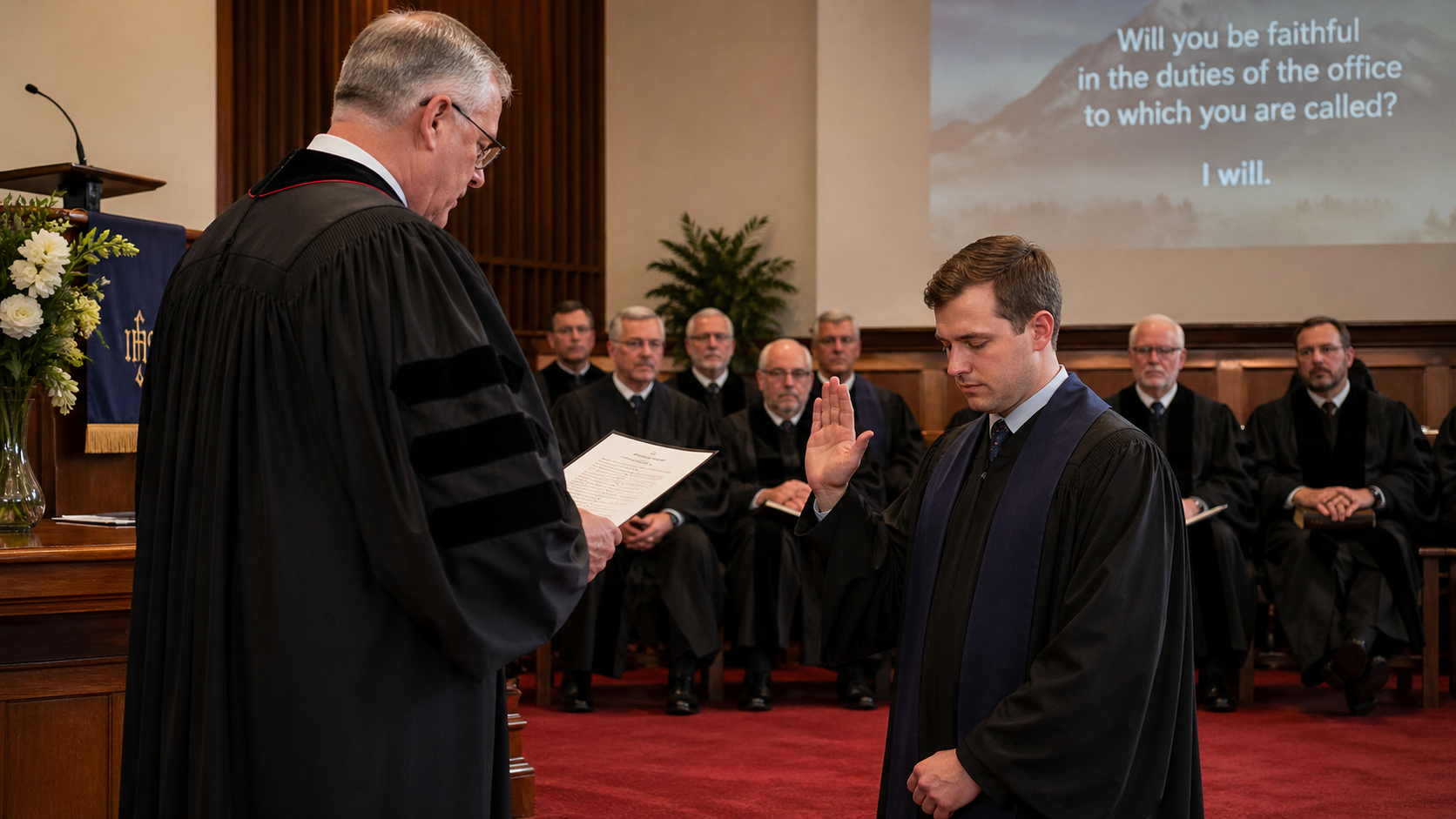
Some have compared the Confession to the US Constitution and have advocated a form of subscription analogous to “Strict Constructionism.” In this case, a creed or confession must always be interpreted and applied in accordance with the intent of its framers. Failure to do so calls into question one’s integrity and signifies that one is not “truly confessional.”1James Renihan labels this view “Historical Subscription.” “Confession Subscription,” a paper presented at the ARBCA General Assembly (March 12, 1998). A slightly updated version can be found in Tom Chantry and David Dykstra, Holding Communion Together: The Reformed Baptists: The First Fifty Years, Divided & United (Vestavia Hills, AL: Solid Ground Books, 2014), 278. The argument comparing the Confession with the US Constitution seems, on the surface, compelling. After all, no one wants to treat the Confession as a “living document” whose meaning is ever-evolving and changing. However, as my friend John Sweat has noted, “The Constitution is the norma normans (the rule that rules) of the country to which all courts and legislation must bow to. The confession is a theological summary that is subordinate to the ultimate standard, Scripture. The confession is a norma normata (a rule that is ruled) underneath the norma normans, Scripture. So, when we compare the confession and the Constitution in making a case for authorial intent, we are equating a norma normata with a norma normans.” (Email to author, June 21, 2025). Thus, the comparison of the Confession with the US Constitution breaks down.
The Question of Authorial Intent
Is authorial intent important for choosing and using a confession? Yes and no. On the one hand, understanding what the author(s) of a creed or confession meant by a particular statement within that symbol is certainly helpful in determining whether that formulation captures our own belief about a given doctrine. On the other hand, it can be challenging to ascertain the precise authorial intent behind statements in a document whose authors are no longer living and whom, therefore, we cannot interview.
Case Study: “God … without parts”
For example, what did the framers of the Westminster Confession intend by the phrase “God [is] … without … parts” (WCF 2.1). All agree that this is an affirmation of the doctrine of divine simplicity (DDS). But anyone familiar with the history of that doctrine knows that theologians through history have formulated different versions, some less developed and “weaker” (the Cappadocian Fathers), some more philosophically robust and “stronger” (Augustine and Aquinas), and some more nuanced and “moderate” (Duns Scotus).2See the helpful summaries of the various models of divine simplicity and how they differ in Thomas H. McCall, “Trinity Doctrine, Plain and Simple,” Advancing Trinitarian Theology, ed. Oliver D. Crisp and Fred Sanders (Grand Rapids, MI: Zondervan, 2014), 42–59; Oliver Crisp, Analyzing Doctrine: Toward a Systematic Theology (Baylor, TX: Baylor University Press, 2019), 53–75; Jordan Steffaniak, Classical Theism: A Christian Introduction (Bellingham, WA: Lexham Academic, 2026), 151–206; and, most recently, Ross Inman, ed. Contemplating Divine Simplicity: Five Views (London: Bloomsbury Academic, 2026). So, the question arises: Is the Confession demanding one of these versions of the DDS? If so, which version? Or is the Confession’s language purposefully sparse to allow for the most basic and minimal affirmation?
Considering the Puritan’s commitment to the supremacy of Scripture (WCF 1.10; 31.3), their eclectic appropriation of the classical Christian tradition,3See Richard A. Muller, “Reformation, Orthodoxy, ‘Christian Aristotelianism,’ and the Eclecticism of Early Modern Philosophy,” Nederlands Archief Voor Kerkgeschiedenis 81, no. 3 (2001): 321–22; Jordan Steffaniak, “Making the Great Tradition Great Again: A Classical Defense of Modern Metaphysics” (paper presented at the Convivium Irenicum 2022, Davenant House, Landrum, SC, June 1–4, 2022). and their aim in producing a consensus document,4Consensus documents aim for unity, not uniformity. They are inclusive by nature and aim to accommodate variations of a doctrine without compromising its core concerns. I’m inclined to think that they are simply calling for an affirmation of the doctrine in its most basic and minimal form. Namely, (1) that God is a se, (2) that he’s a necessary being, (3) that he’s a “pure Spirit” without a body, and (4) that his attributes are not “parts” that can exist independent of God or one another but are co-extensive, co-essential, and mutually entailing.5See Oliver Crisp, who argues for a “parsimonious model,” Analyzing Doctrine, 70–75, and Jordan Steffaniak, who identifies the essential requirements for a “mere divine simplicity,” Classical Theism, 155–165. Inman reduces the essential requirements even further. Contemplating Divine Simplicity, 3–4. Similarly, after referencing the several Reformed confessions, including the WCF and 2LCF, Jordan Steffaniak observes, “From these alone, the main expressions of the Reformed faith all self-consciously confess that God is simple. However, these do not provide explanation beyond the negative phrasing of without body or parts.” He goes on to note, “Most Protestant confessions either elude the language of simplicity or leave it undefined, allowing the confessional church and individual a significant degree of latitude. Divine simplicity is certainly part of confessional dogma, but the particular model appears to be up for debate.”6Steffaniak, Classical Theism, 165, 167.
But Suppose the Framers were Thomists
But let’s suppose someone demonstrates that a significant majority of the 120 Westminster divines favored the more robust, Thomist version of the DDS. Suppose one could further show that such was probably their “authorial intent” when they penned the phrase “God without parts.” Would that fact demand that we must confess the Thomist DDS today if we wish to be “truly confessional”? No. Let me explain why.
The Scripture Alone is the Final Authority
First, Scripture alone is the only infallible authority for faith and life (WCF, 2LCF 1.1, 10). Confessions, on the other hand, are human and fallible. “Therefore, they are not to be made the rule of faith, or practice; but to be used as a help in both” (WCF 31.3). For this reason, C. H. Spurgeon commended the 2LCF to his congregation with this qualification: “This little volume is not issued as an authoritative rule, or code of faith, whereby you are to be fettered, but as an assistance to you in controversy, a confirmation in faith, and a means of edification in righteousness.”7From the Preface of Spurgeon’s republished version (1855) of the Second London Confession, cited in The Baptist Confession of Faith 1689 (Edinburgh: Banner of Truth, 2012), 14. Thus, a creed or confession’s authorial intent has authority (derivative) only insofar as it clearly conforms to the teaching of Scripture. For instance, the fact that some form of baptismal regeneration was the prevailing view when the Nicene Creed was penned does not mean that we must adopt baptismal regeneration when confessing the Creed’s “one baptism for the remission of sins.”8“The dominant belief throughout the fourth century was that baptism effects the forgiveness of sins and new birth.” Everett Ferguson, Baptism in the Early Church (Grand Rapids: Eerdmans, 2009), 486; See also J. N. D. Kelly, Early Christian Doctrines (San Francisco, CA: Harper & Row, 1978), 194–95; David F. Wright, What has Infant Baptism Done to Baptism (Carlisle, United Kingdom: Paternoster, 2005), 42. Rather, as we’ll argue below, a church or denomination may impose what it believes to be a biblical understanding of baptism when confessing the Creed.
The Confession Reflects Its Historical Context
Second, confessions reflect the historical context in which they were written. Accordingly, they may contain or reflect underlying philosophical assumptions that should not be necessarily binding today. For example, with Sir Isaac Newton’s discovery of gravity, many scientists rightly ditched Aristotle’s theory of motion. But if there are problems with the physics of ancient Greece, perhaps there are flaws in the (more speculative) metaphysics of ancient Greece.9“Physics” is more empirically based (inductive) and focuses on causes and effects in the physical phenomena of the universe. “Metaphysics” is more rationally based (deductive) and focuses on the fundamental nature of reality, being, existence, and the relationship between things beyond what is open to empirical observation. Thus, metaphysics tends to be more speculative in nature. For a brief account of modern science’s rejection of Aristotle’s theory of motion and modern philosophy’s rejection of Greek metaphysics, see Jeffrey Koperski, “God, the Laws of Nature, and Occasionalism,” Religious Studies (2023), 1–14. At the very least, philosophical frameworks and assumptions that are not derived from Scripture and that are not clearly self-evident, should not be elevated to dogma.10Take, for example, the Platonic assumption that all change whatsoever is either for the better or for the worse (see The Republic, 2.381; cf. Aristotle, Metaphysics, 12.1074b). This is not taught in Scripture. Nor is it self-evident since there are many “value neutral” changes in the physical world. Therefore, to insist on a doctrine of divine immutability that renders God immobile and precludes relational (Cambridge) changes is to go beyond Scripture and clear reason. As William Evans remarks,
We cannot repristinate the worldviews of the confessional authors. Nor should we try to do so. For example, the detailed creedal expressions of the church fathers regarding trinity and Christology were explained at the time in terms that assume the prevailing Platonism of the fathers, but that does not mean that we should become Platonists. Similarly, the texts of the Westminster Standards contained embedded within them certain assumptions about the hierarchical nature of human society, but that does not mean that we should adopt the British class system of the seventeenth century.11“Towards a Confessional Hermeneutic: Some Suggestions (with a bit of commentary)” (October 10, 2011), Reformation 21; accessed June 14, 2025: https://www.reformation21.org/blogs/towards-a-confessional-hermene.php.
Similarly, James Renihan writes, “While [Historical Subscription] has its merits, and we must never ignore the intent of our 17th century brothers, it would seem difficult to maintain this position with any real consistency.”12“Confessional Subscription,” Holding Communion Together, 278.
Each Church Decides How It Chooses to Use a Confession
Third, a confession’s intended meaning and authority is determined by the community that adopts and employs it. The principle of animus imponentis (“the intention of the mind”) means the imposing body (church, denomination) has the right to impose its understanding and intention on the creed or confession it adopts and employs. William Evans agrees and writes, “The normativity of a confession lies in the text as it is interpreted by the believing community. Authorial intent is important, but it is not in the final analysis, determinative.”13Evans, “Towards a Confessional Hermeneutic.”
Let me highlight two cases in which Reformed ecclesiastical bodies chose not to limit the meaning of a creedal statement to authorial intent but purposefully broadened its range of meaning to allow for other views.
The Regulative Principle
The first example is seen in “A Position Paper Concerning the Regulative Principle of Worship” that the Association of Reformed Baptist Churches of America adopted in 2001. After providing a commentary on Chapter 22 of the 2LCF (“Of Religious Worship and the Sabbath Day”), the Paper not only rejects exclusive psalmody but allows for the use of musical instruments and even forms of “special music.”14“A Position Paper Concerning the Regulative Principle of Worship” (2001), 17–22. An online version is available on the Confessing Baptist Association, accessed June 17, 2025: https://www.cba1689.com/regulative-principle. This is in spite of the fact that the prevailing understanding of the RPW among the Puritans limited congregational singing to the Psalter and excluded the use of musical instruments in worship.15See John McNaughter, The Psalms in Worship, A Series of Convention Papers bearing Upon the. Place of the Psalms in the Worship of the Church (1907; reprint, London, U.K.: Forgotten Books, 2018); John Price, Old Light on New Worship: Musical Instruments and the Worship of God, a Theological, Historical, and Psychological Study (Avinger, TX: Simpson Publishing, 2005). Thus, for ARBCA, it was not ultimately “authorial intent” that defined the Confession’s meaning and authority for the Association but the Association’s own intent in using the Confession.
The Descent Clause
The second example is found in the Westminster Confession of Faith and Second London Confession. According to the Apostles’ Creed, Jesus “descended into hell [Hades, spirit-world]”16Philip Schaff, The Creeds of Christendom, with a History and Critical Notes: The Greek and Latin Creeds, with Translations, vol. 2 (New York: Harper & Brothers, 1890), 45. between his death and his ascension. At the time the Creed was being formed,17Broadly, the formation of the Creed took place between the second- and eighth-centuries. the dominant view of Christ’s descent was that His soul went to Sheol (the realm of the dead) to rescue the faithful, triumph over Satan, and declare His righteous victory to the imprisoned spirits.18For helpful studies that support this view, see Matthew Y. Emerson, “He Descended to the Dead”: An Evangelical View of Holy Saturday (Downers Grove, IL: IVP, 2019); Samuel D. Renihan, Crux, Mors, Inferi: A Primer and Reader on Christ’s Descent (Independently Published, 2021). However, as Samuel Renihan notes, “certain wings of the Protestant Reformation redefined and thus rejected the Creed’s theology while retaining its words.”19Crux, Mors, Inferi, 205–06. John Calvin understood Christ’s descent metaphorically as his suffering God’s wrath on the cross. Some later Reformed writers interpreted it as referring to the state of death. The WCF says that Christ “was crucified, and died; was buried, and remained under the power of death” (WCF 8.4). Similarly, the 2LCF says he “remained in the state of the dead” (2LCF 8.4). Thus, we have a case where Reformed confessions retain the wording of an earlier creedal statement but do not follow the probable authorial intent behind it.20For a defense of the Reformed view of the descent clause, see Cornelius P. Venema, What We Believe: An Exposition of the Apostles’ Creed (Grandville, MI: Reformed Fellowship Inc., 1996), 61–70; Daniel R. Hyde, In Defense of the Descent: A Response to Contemporary Critics (Grand Rapids, MI: Reformation Heritage Books, 2010).
Conclusion
In light of these considerations, while authorial intent can enrich our understanding of a creed or confession, it is neither always accessible nor ultimately authoritative. Confessions serve the church as fallible guides subordinate to Scripture, and their ongoing use must reflect the theological convictions and interpretive responsibility of the confessing community. Therefore, the authority and meaning of doctrinal standards must be grounded in their faithfulness to Scripture and their relevance within the believing community, rather than in a strict and inflexible adherence to the intentions of their original framers.
* This article is an excerpt from my chapter “Choosing and Using a Confession: Some Biblical and Theological Guidelines,” in The Confessing Baptist: Essays on the Use of Creeds in Baptist Faith and Life, 2nd Edition (Free Grace Press, 2025). Used with permission.
Leave a Reply